
Where everything in every moment can change into almost anything.
There’s a peculiar comfort in the Proteus universe’s central insight:
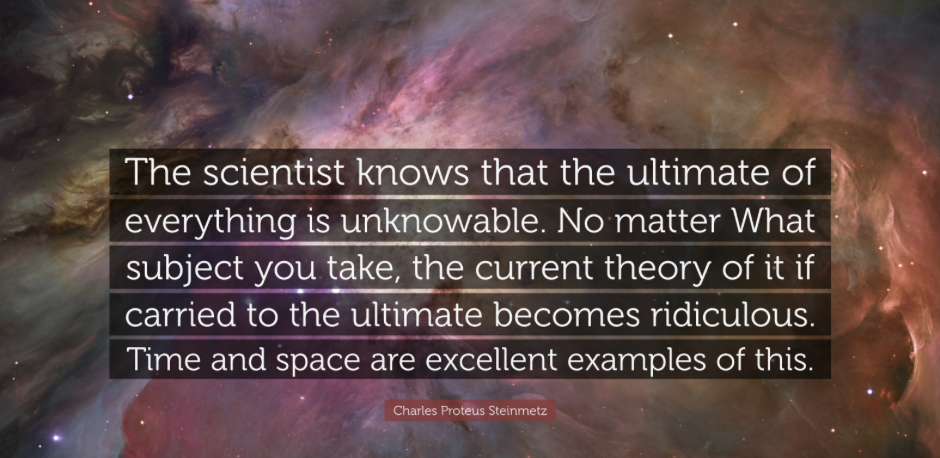
The scientist knows that the ultimate of everything is unknowable. No matter what subject you take, the current theory of it, if carried to the ultimate, becomes ridiculous.
Take time and space—our most fundamental dimensions of existence. Push physicists hard enough about what space actually is, and you’ll watch their certainty dissolve into quantum foam, string vibrations, or mathematical abstractions that bear no resemblance to the tangible world we navigate daily. Ask what came ”before” the Big Bang, and language itself breaks down. Before implies time, but time began with the universe. The question eats its own tail.
The Proteus perspective doesn’t counsel despair at this unknowability—it suggests liberation. We spend so much energy pretending our models are reality rather than maps, defending theories as if they were sacred truths rather than useful approximations. But push any explanation far enough and you hit the wall: turtles all the way down, infinite regress, or the simple honest answer: ”We don’t know, and perhaps cannot know.”
This isn’t an argument for ignorance or mysticism. Science remains our best tool for understanding the universe. But the Proteus wisdom reminds us to hold our certainties lightly. Today’s unshakeable truth is tomorrow’s quaint misconception. The atom was indivisible until it wasn’t. Space and time were absolute until Einstein showed they were relative. Reality itself may be far stranger than our current paradigms allow us to imagine.
The ultimate becomes ridiculous not because we’re foolish, but because we’re finite minds grasping at infinite questions. And that’s perfectly fine.